
Climate Risks & Opportunities Assessment
Help your company identify potential threats from climate change while uncovering strategic opportunities to build resilience and long-term value.

Get Data You Can Count On
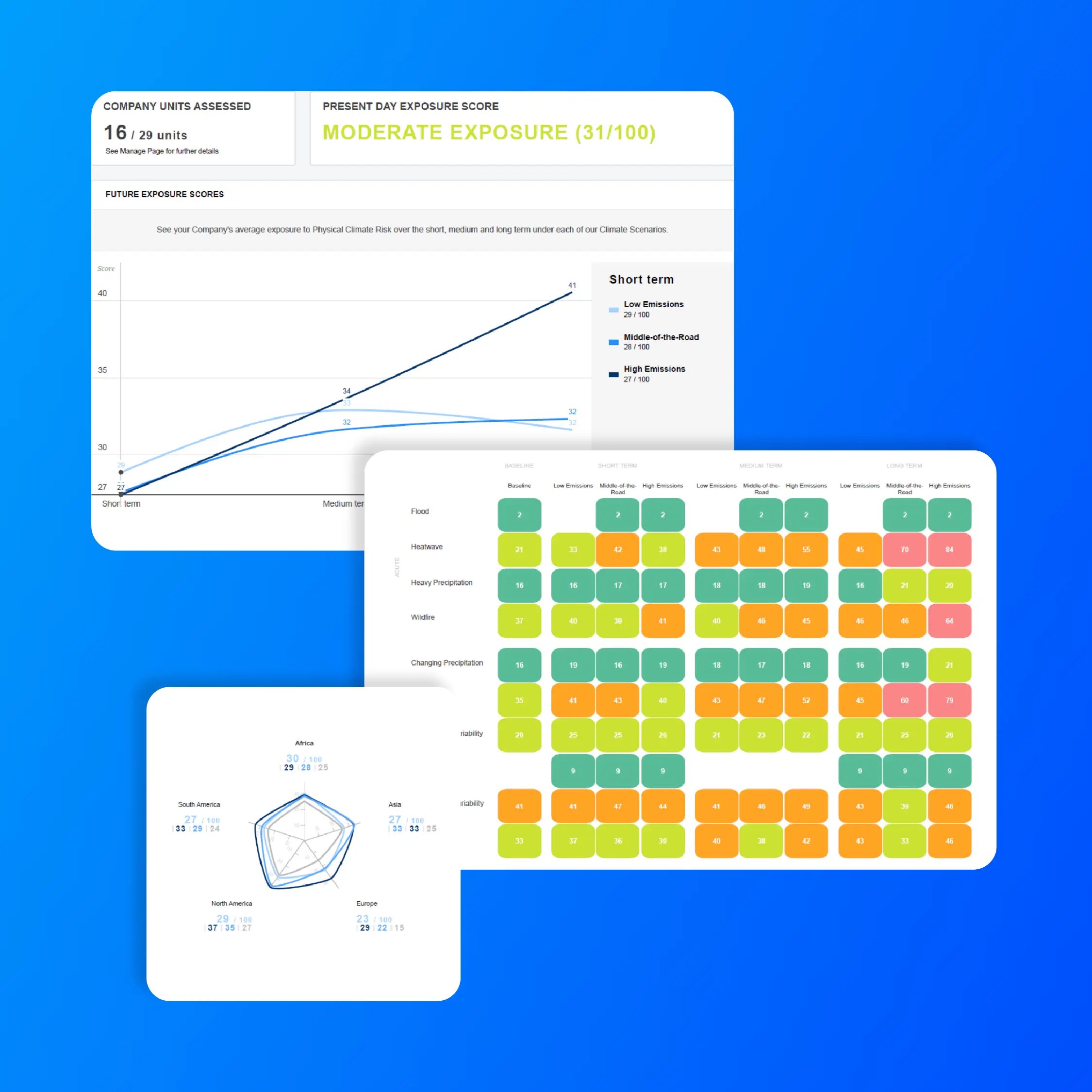
Understand your company’s operational exposure to key climate hazards
Acute & chronic perils
Globally recognized scientific databases
Shared socioeconomic pathway scenarios

Understand how your company’s physical assets (e.g., offices, factories) will be affected by climate change under a variety of future global warming scenarios.
Analyze your company’s transition risks associated with the decarbonization of the economy, by looking at four TCFD-aligned risk categories.
Identify strategic next steps to mitigate or adapt to climate-related risks, while simultaneously leveraging opportunities to build long-term resilience and competitive advantage.
Why conduct a climate-related risk assessment?
It enables companies to anticipate how climate change may impact their operations, supply chains, and markets while identifying opportunities to innovate and build resilience

Comply with regulations
Meet regulatory requirements, such as California’s SB 261, and enhance reporting against voluntary frameworks such as CDP and ISSB

Implement a plan
Integrate climate-related risks into enterprise risk management planning and business strategy

Communicate findings
Share material physical and transition risks to key stakeholders, including customers, suppliers, the board, or investors

Identifying your climate-related risks & opportunities is a foundational step to future-proofing your business and ensuring the long-term resiliency of your operations, no matter what the future may hold.
Annie Roberts
Senior Vice President - Climate ConsultingUnderstanding the mission
A tool to identify and assess different climate futures and how that could impact different physical and transition climate risk exposures.
Acute risks refers to the chance of sudden, extreme events such as floods or wildfires, whereas chronic risks would stem from long-term climactic and environmental changes, such as rising temperatures and sea-level rise.
Specific periods for assessing climate-related impacts vary across scientific databases for physical and transition risks but often include similar time frames to the following: baseline (present day), short term (2030-2040), medium term (2040-2050) and long term (2050+).
The following transition risks are analyzed in line with TCFD guidance: policy and legal, market, technology, reputational.
Low emissions (SSP1-1.9), middle-of-the-road (SSP2-4.5) and high emissions (SSP5-8.5) scenarios.
SSPs (Shared Socioeconomic Pathway) explore the socio-economic factors that influence emissions and climate change, such as population, economic growth, and technological development.
RCPs (Representative Concentration Pathway) focus on radiative forcing and GHG concentrations.
Let's start a conversation.
related Services
Explore what else G&A can offer



Understand what’s shaping sustainability.
Dive into blog posts that break down trends and emerging issues.
Explore the Blog
 July 2025